
Sound familiar?
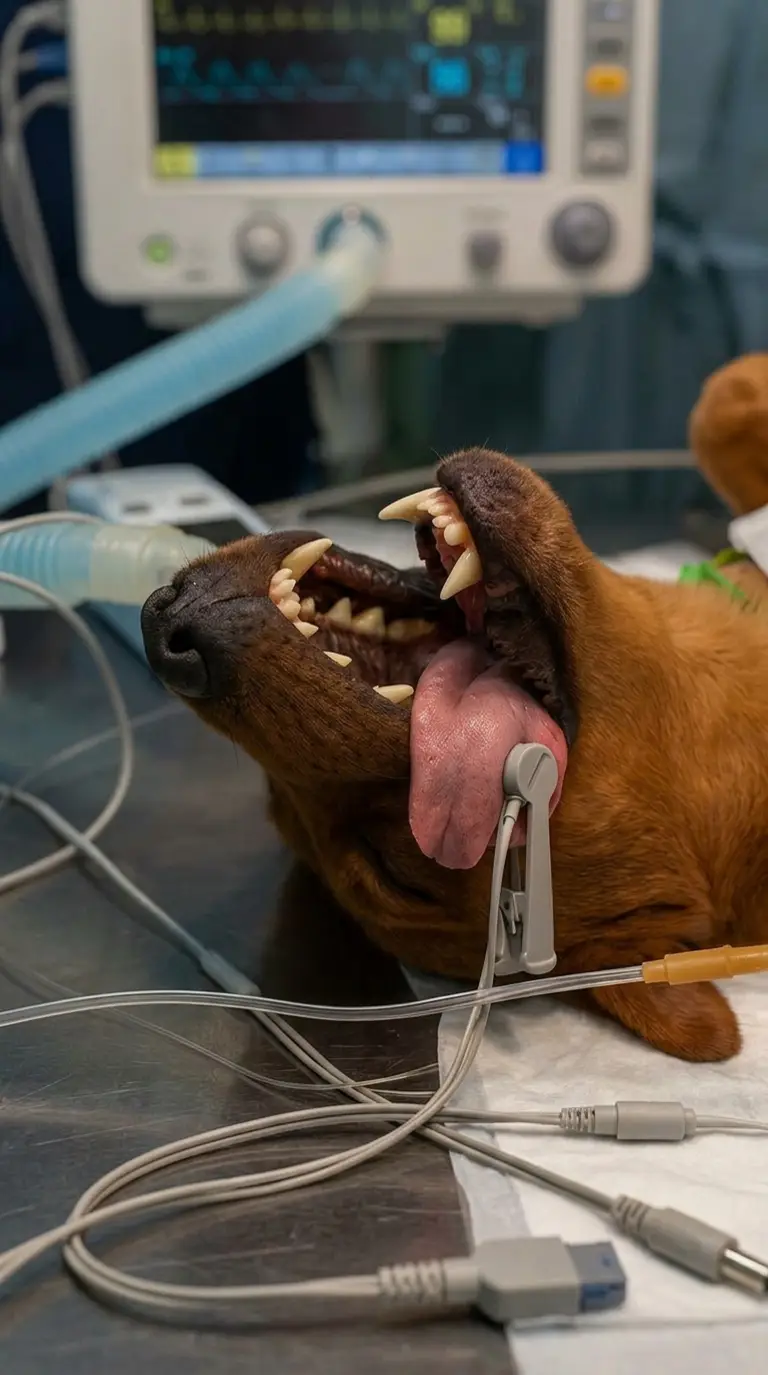
Someone's pet is under anaesthesia. You're repositioning the plate for the third time. The patient is losing temperature. The image comes back and you're not even sure what you're looking at.
- ✕ "I hate dental X-rays"
- ✕ "I don't know what I'm looking at"
- ✕ "This is taking forever"
- ✕ "I don't feel confident charging for these"
That isn't bad luck. It's the dental X-ray vicious circle.
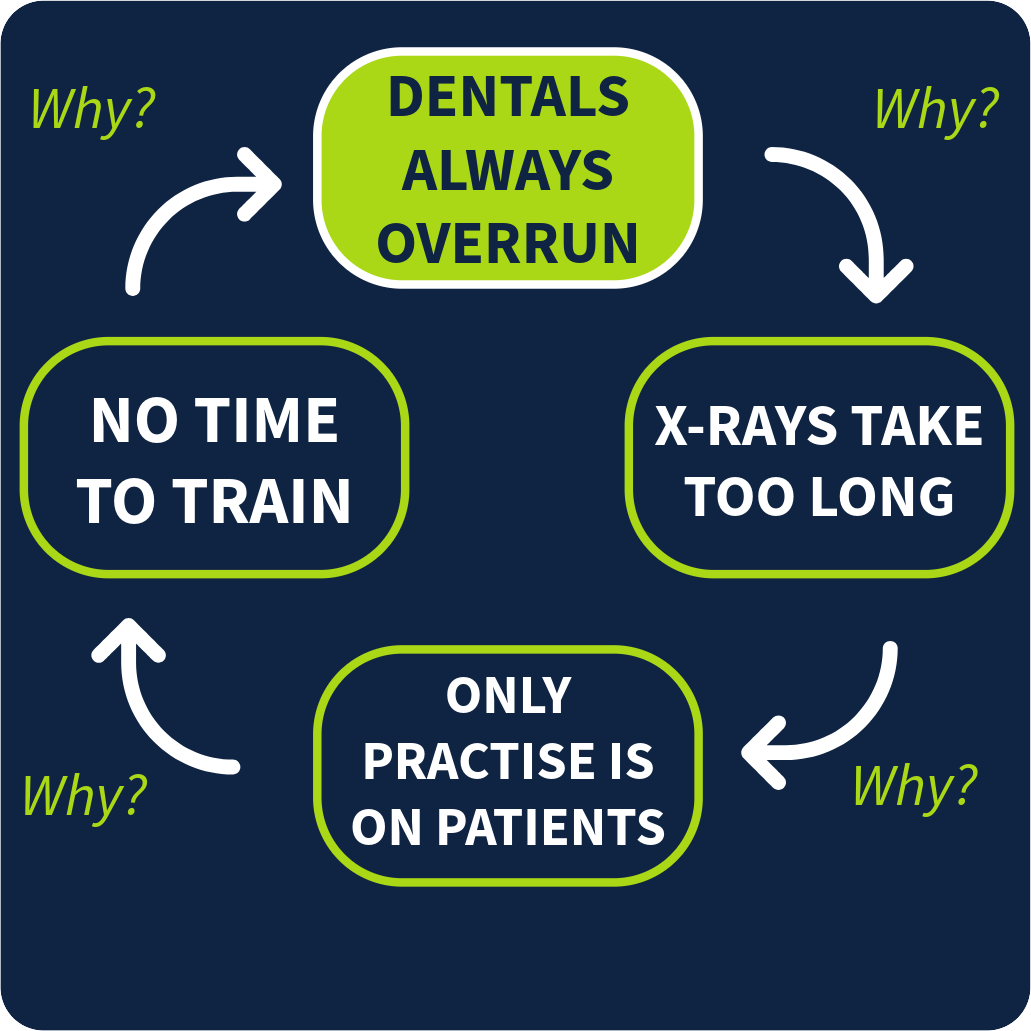
The lost minutes are the least of it.
- The patient is under anaesthesia longer than they need to be — losing temperature, and carrying every extra minute of risk that comes with it.
- The machine you paid for earns a fraction of what it could. Every slow dental is theatre time you can't sell twice.
- Studies come back incomplete, so nobody bills for them with confidence — and whatever's in that mouth goes unfound.
- One person can really do it. The day they leave, you're back to zero — and so is everything you spent getting them there.
None of this is a knowledge problem. So the answer isn't trying harder inside the circle — it's breaking it.
GAIA Training System
How it worksThe models & posters
In your X-ray room
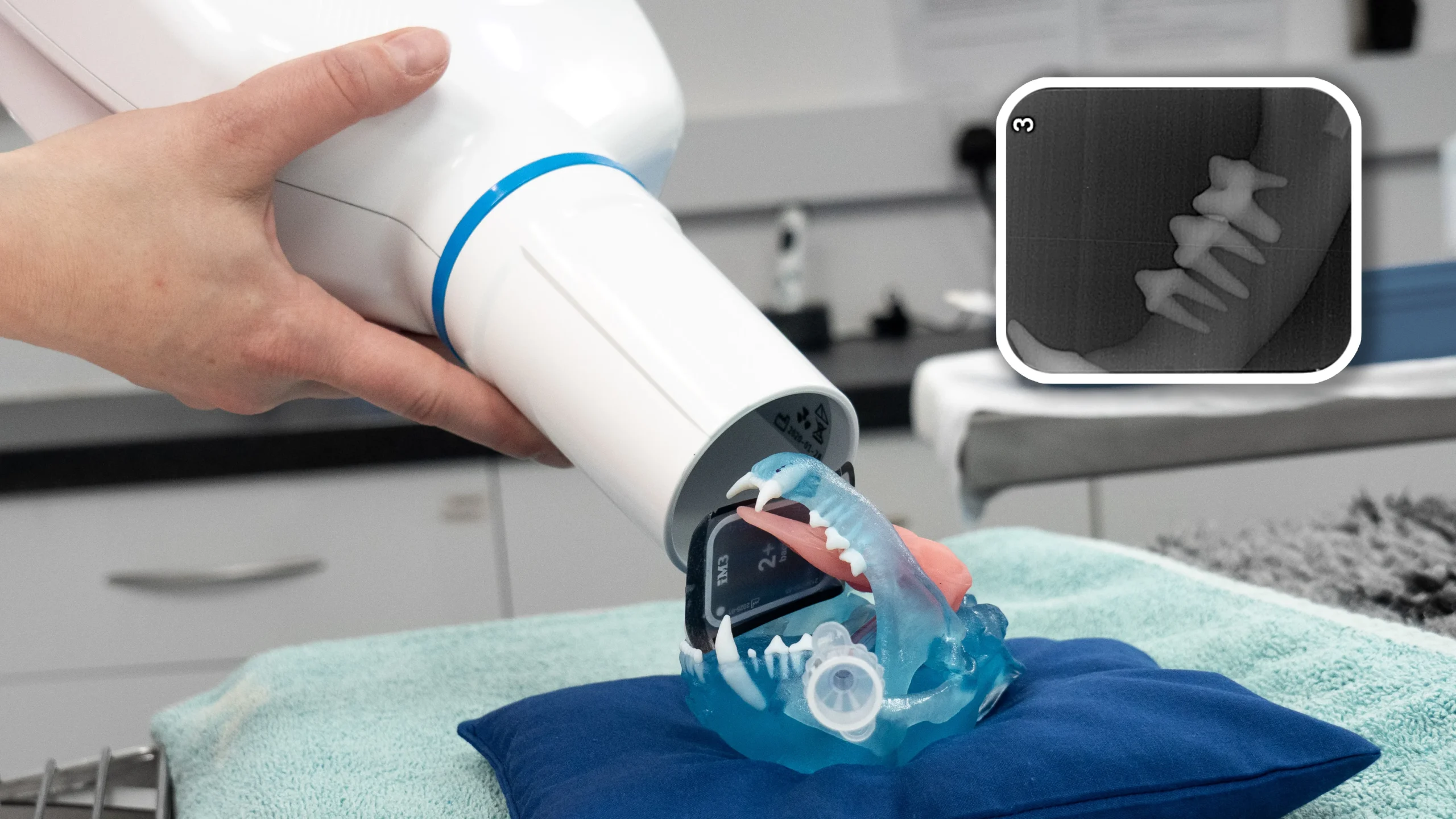
Betty and Mr Domino go under your own unit. Soft tissue, tongue, ET tube, all the things that make a real patient difficult.
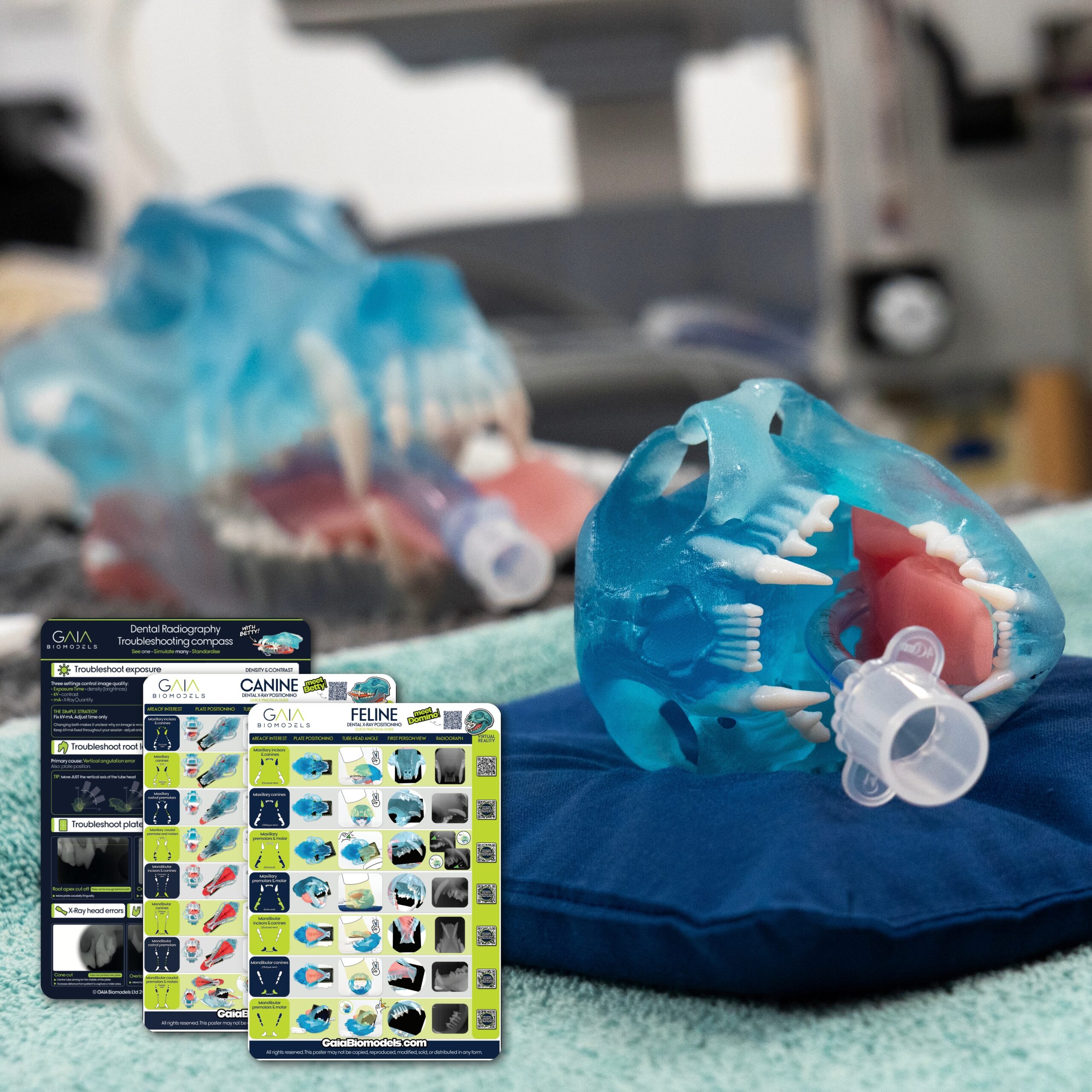
The posters stay next to the machine. A QR on every view opens its virtual model with no login, and the troubleshooting poster shows them what went wrong and what to change.
Nothing they do on the models can go wrong. No patient, no clock, and no consequence to getting it wrong twenty times before getting it right.
- Your own machine
- No anaesthesia
- QR to every view
- Repeat as often as you like
The course
On every device
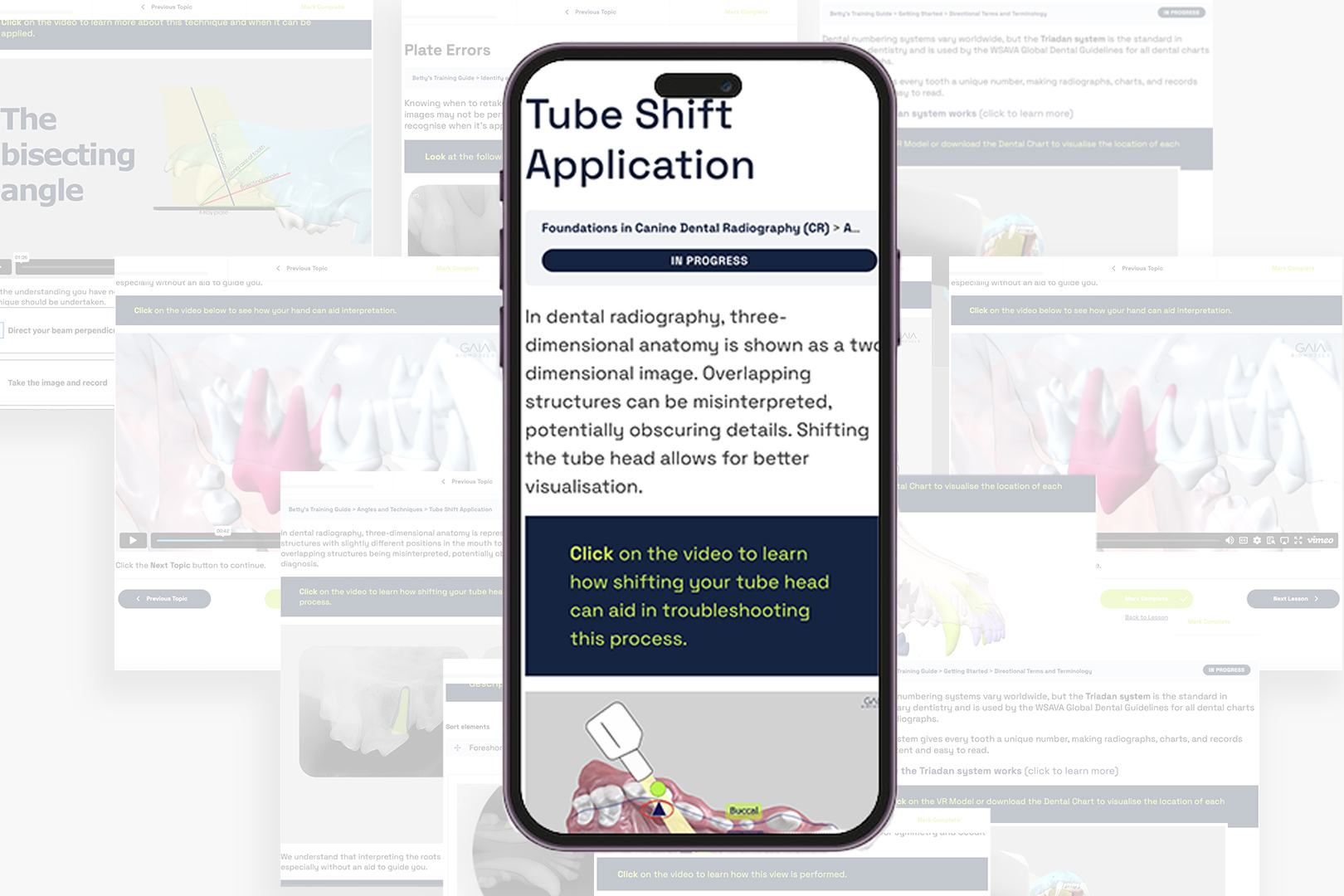
Every view, dogs and cats. Where the plate goes, how to angle the beam, what a diagnostic image looks like, and what to do when it comes back wrong. Troubleshooting is most of the job, and we cover all of it.
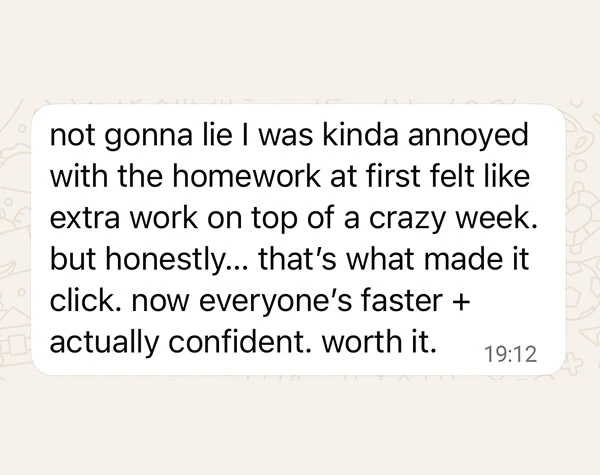
Sessions run 15 minutes, which is the reason this survives a working week. One login per user, no set dates, and no course to book.
- 25 lessons
- 10 simulations
- A virtual model for every view
- 15 minutes a session
The method
So it actually happens
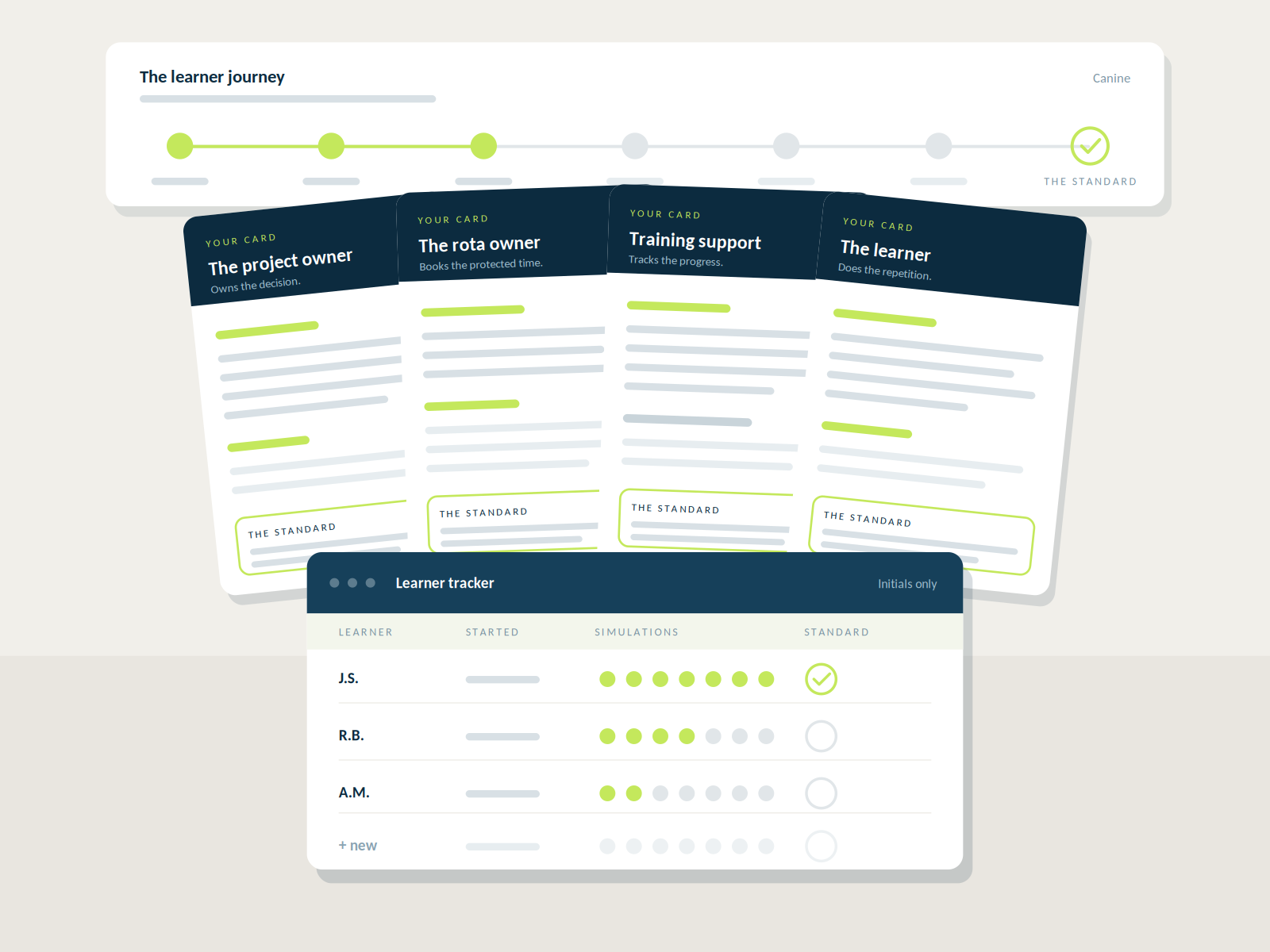
One deployment call sets it up. Four responsibilities, one task each: who signs it off, who protects the time, who keeps an eye on progress, and who's learning.
None of the four teach anybody. The course does that, so you don't need someone on the team who already knows dental radiography. The person watching progress doesn't need any knowledge either.
We're there when a group starts, and again when the next one does. You watch the tracker instead of chasing anyone.
- 4 responsibilities
- Nobody teaches
- One tracker
The standard
There's a clear finish line, and it isn't finishing the course.
Two full-mouth series on the models, every view, no more than two troubleshooted retakes between them, under 20 minutes, on separate occasions.
What our clients say
"This has enabled our team to take more consistent diagnostic x-rays."
Read the full message
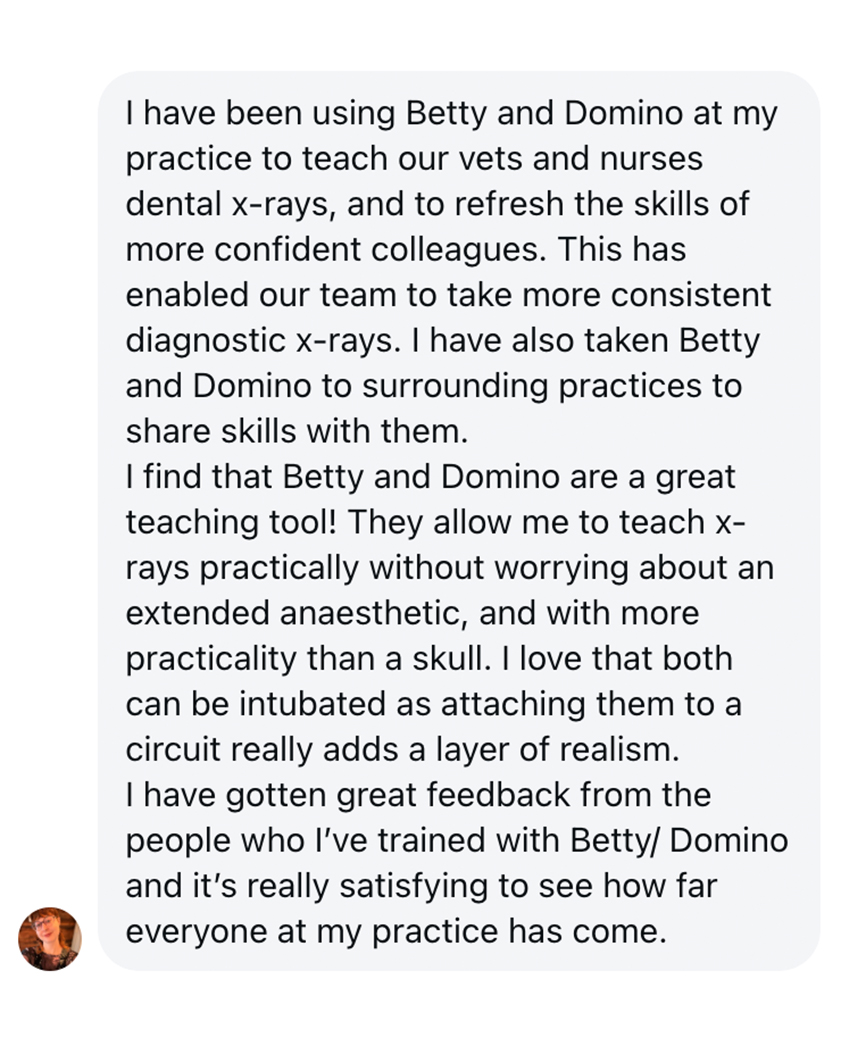
"I have been using Betty and Domino at my practice to teach our vets and nurses dental x-rays, and to refresh the skills of more confident colleagues. This has enabled our team to take more consistent diagnostic x-rays. I have also taken Betty and Domino to surrounding practices to share skills with them.
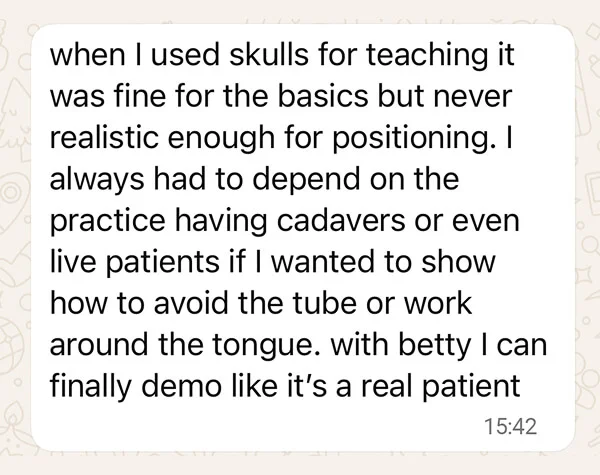
I find that Betty and Domino are a great teaching tool. They allow me to teach x-rays practically without worrying about an extended anaesthetic, and with more practicality than a skull. I love that both can be intubated as attaching them to a circuit really adds a layer of realism.
I have gotten great feedback from the people I've trained with Betty and Domino and it's really satisfying to see how far everyone at my practice has come."
"I loved learning the WHY behind the angles. Understanding the 'why' really helped me troubleshoot."
Read the full message
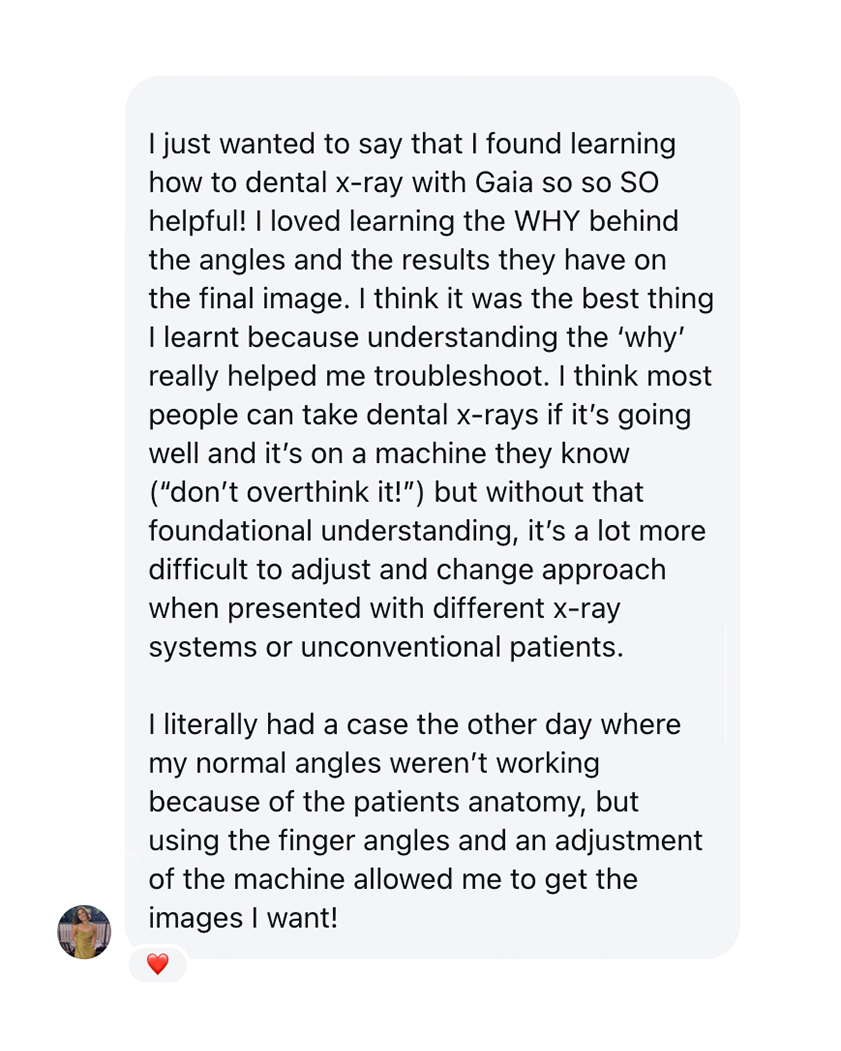
"I just wanted to say that I found learning how to dental x-ray with Gaia so so SO helpful! I loved learning the WHY behind the angles and the results they have on the final image. I think it was the best thing I learnt because understanding the 'why' really helped me troubleshoot.
I think most people can take dental x-rays if it's going well and it's on a machine they know ("don't overthink it!") but without that foundational understanding, it's a lot more difficult to adjust and change approach when presented with different x-ray systems or unconventional patients.
I literally had a case the other day where my normal angles weren't working because of the patient's anatomy, but using the finger angles and an adjustment of the machine allowed me to get the images I want!"
"Especially valuable for training new team members and for refining imaging techniques."
Read the full message
"We use Betty and Domino in our clinic, and they have become an essential educational tool for our team. These models provide a realistic way to practice and improve dental radiography skills.
The models are especially valuable for training new team members and for refining imaging techniques. They help bridge the gap between theory and real clinical practice.
We highly recommend these models to any veterinary clinic that wants to strengthen its dental radiography training and educational standards."
"Dog skulls were unrealistic, difficult to position and fragile. Betty and Domino have revolutionised this part of the training."
Read the full message
"As the CVS graduate programme lead I am constantly looking for ways to improve the learning experience on our graduate CPD courses. One of the ways I do this is by reviewing vast amounts of anonymous feedback.
Before Betty and Domino, we consistently had feedback saying how regular dog skulls were unrealistic for practicing dental xrays, difficult to position and fragile. Betty and Domino have revolutionised this part of dental x ray training, they are realistic, easy to position and robust, producing excellent images and avoiding the mess or biohazard that xraying cadavers would bring. 100% would recommend!"
"The tongue lets learners visualise plate placement. A much clearer representation than a skull alone."
Read the full message
"As someone who regularly teaches dental radiography to both veterinary surgeons and veterinary nurses, the Gaia Biomodels have become an invaluable part of my educational toolkit.
Compared with traditional teaching methods using real skulls or cadaver material, the Gaia models offer significant advantages. Their robustness means they can withstand repeated handling without the fragility and maintenance concerns associated with real specimens. They also eliminate the ethical considerations that can arise when using biological materials.
One of the standout features is the inclusion of a tongue within the models. This simple but highly effective addition allows learners to better visualise plate placement and understand the spatial challenges involved in maxillofacial imaging. It offers a much clearer representation than a skull alone.
The ability to use these models in dry-lab teaching has transformed the reach of our educational programmes. Without the need for cadaver material, we can deliver high-quality, hands-on training to far greater numbers of veterinary professionals.
More recently, the addition of the Shadow Monster to my teaching kit has further enhanced learning. It provides an outstanding visual aid for demonstrating procedures and helps learners develop a clearer understanding of the step-by-step process.
Gaia Biomodels have genuinely elevated the quality of my teaching. They provide realistic, durable and ethically responsible training tools that enable learners to build their skills in a way that traditional teaching resources simply cannot match."
"A reduction in the use of cadavers for dental radiography. Less manual handling, less mess, and delegates love them."
Read the full message
"I'm the Training Centre Coordinator for the IVC Training Centre in Birmingham. We were fortunate to be early adopters of Betty, the canine dental radiography model, and more recently of Mr Domino, the feline version from Gaia Biomodels.
In the time we've had these models, they've already proved invaluable in delivering our dentistry courses for general practice vets and nurses. The models are easy to handle, intuitive to use for demonstrations, and allow delegates to practice dental radiography safely and confidently.
Javier and Rachael bring unmatched enthusiasm and scientific skill to their craft. I do consider their models to be functional works of art. Alongside their dental models, Gaia's digital and poster resources are outstanding.
Main impacts to my job: delegates love them and find them very useful. A reduction in the use of cadavers for dental radiography. I still think cadavers currently have a place, but we can get away with using fewer of them for the radiography sections of courses, which means less manual handling and mess. They're beautiful, I enjoy having them on display and they are a great talking point when giving tours to clinical and non-clinical people alike.
Built with dental specialists and educators. Based on the same simulation-before-patients approach used in human medical training.
Not ready to talk yet?
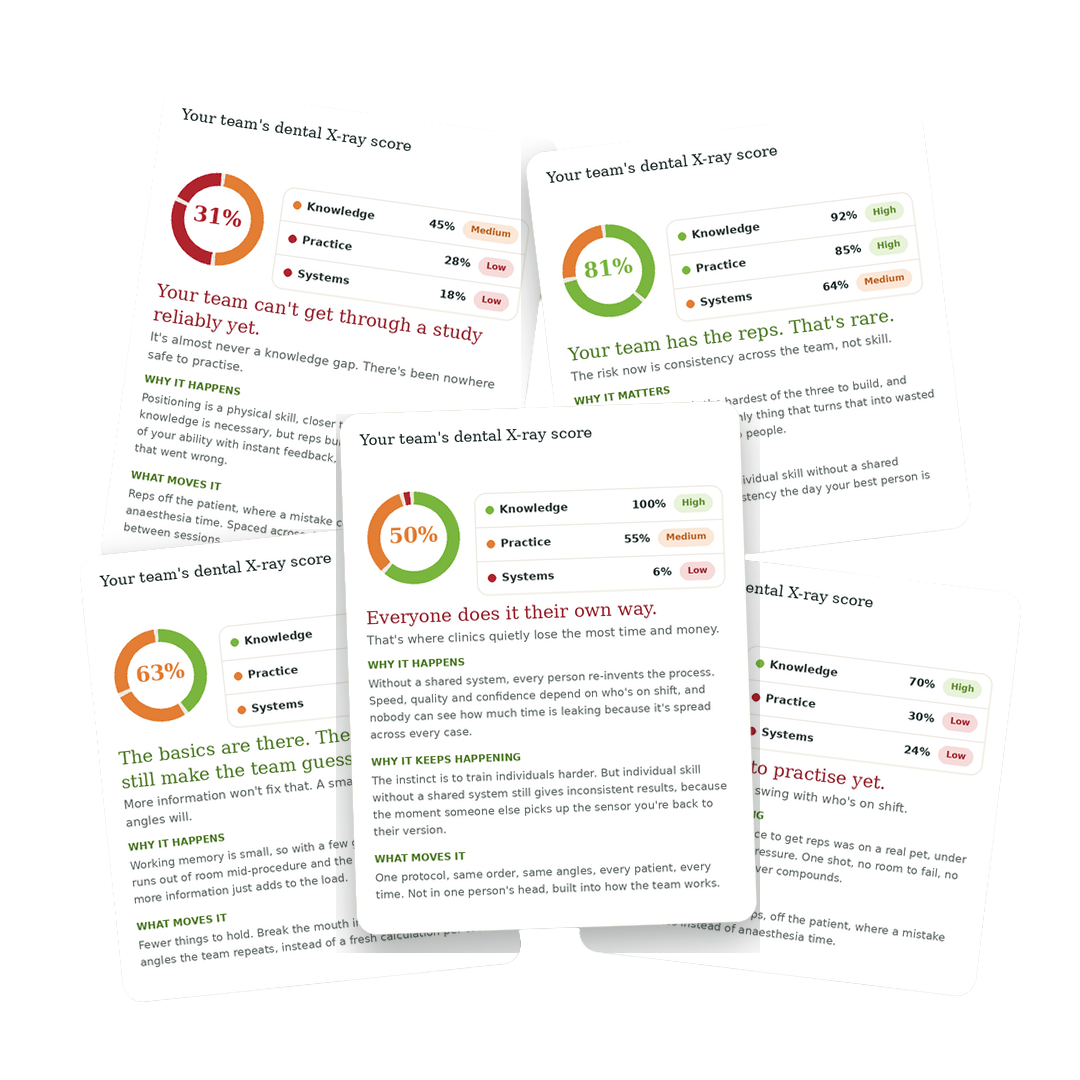
Find out what's actually slowing your dentals down.
Three minutes, free, no call. You'll get a straight answer on why dental radiographs are still slow in your practice, and what moves it. It's the same diagnosis we'd do on a call, so if you talk to us later, we skip the basics.
Take the free assessment